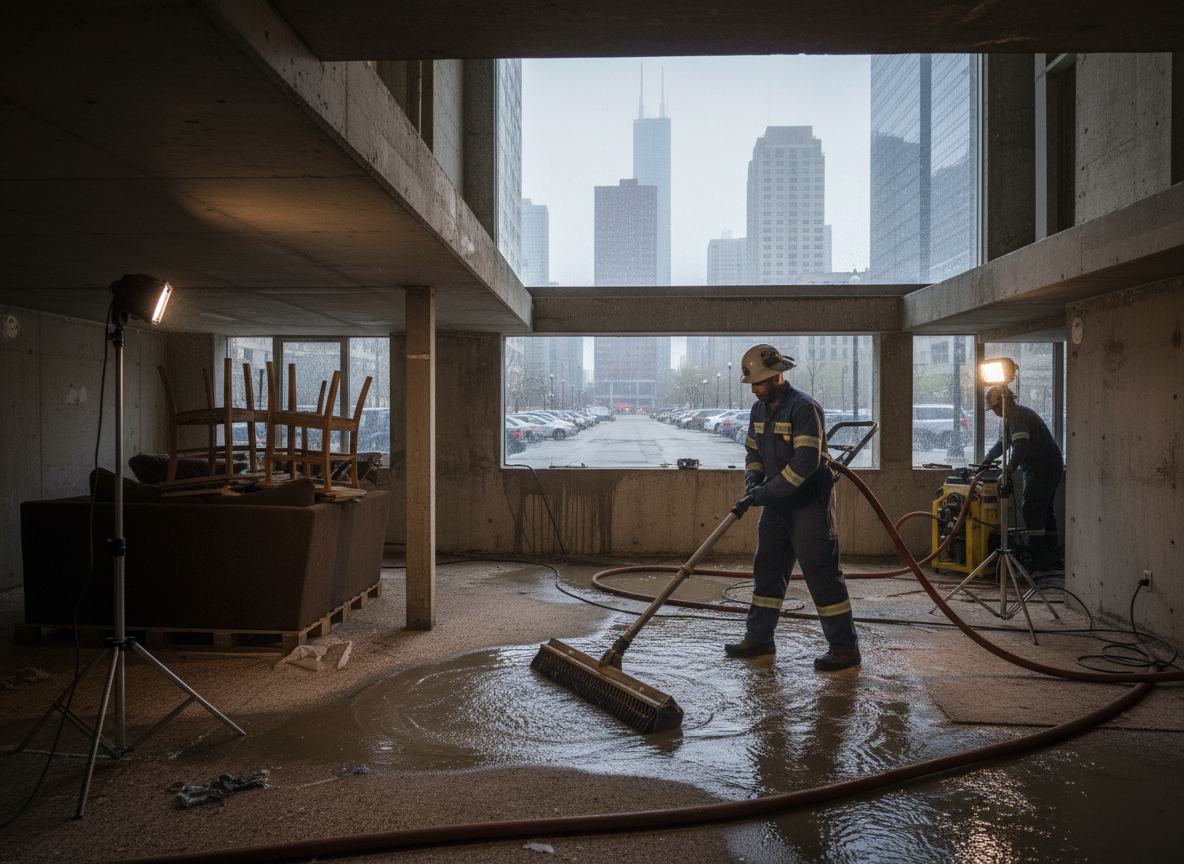
Chicago’s humid continental climate brings cold winters that freeze pipes in pre-1940 brick two-flats common in Lincoln Park and Wicker Park, then sudden thaws send water through plaster walls and into joist pockets. Extraction crews must pull baseboards and drill weep holes to reach trapped water before it migrates to the unit below. Older balloon-frame construction in Logan Square and Bridgeport means water travels vertically faster than in newer builds, requiring moisture meters at multiple levels.
Summer thunderstorms dump heavy rain on flat-roof buildings in the West Loop and South Loop where downspouts often tie into combined sewers that back up during peak flow. Technicians stage submersible pumps on the sidewalk to stay ahead of inflow while interior crews remove carpet padding and open wall cavities. In Hyde Park and Rogers Park bungalows, clay soil around foundations holds moisture against limestone block, so crews also address exterior grading before final drying.
Evanston and Oak Park homes share the same aging plumbing and narrow lots that limit equipment access, forcing smaller portable extractors and longer drying times. Crews document every step with photos because insurance adjusters in Cook County require proof that hidden moisture was removed from hardwood subfloors and behind built-in cabinetry.
Technician insight
In Chicago the thing that catches most people out with Emergency Water Removal is how quickly water travels through the balloon framing in 1890–1920 homes in Lincoln Park and Wicker Park; once it hits the plaster keys it runs down the entire wall cavity and into the neighbor’s unit before anyone notices.
Frozen Pipe in Logan Square Two-Flat
A January cold snap burst a supply line on the second floor of a 1912 two-flat. Water traveled behind the plaster and into the first-floor ceiling. Crews extracted standing water from both units, opened baseboards on two levels, and ran drying equipment for five days until moisture readings stabilized.
Emergency Water Removal Services We Offer
✓Basement Flood Extraction
Remove standing water from finished and unfinished basements in Chicago two-flats after storms or sump failures, then apply antimicrobial treatment to joists.
✓Pipe Burst Water Removal
Extract water from walls and ceilings after frozen supply lines rupture in Lincoln Park and Andersonville brick buildings, followed by targeted drying behind plaster.
✓Sewage Backup Cleanup
Pump and disinfect Category 3 water from combined sewer overflows common in Pilsen and Bridgeport during heavy rain events.
✓Appliance Leak Extraction
Contain and remove water from refrigerator, washer, or water-heater failures in Lakeview and Uptown apartments before it reaches lower units.
✓Carpet and Pad Removal
Lift and dispose of saturated carpet and padding in Logan Square and West Loop homes while preserving hardwood underneath when possible.
Emergency Water Removal Cost in Chicago, IL
| Service | Typical Range | What Affects It |
|---|---|---|
| Initial emergency extraction visit | $350–$650 | First two hours on site; larger volumes or multi-story homes increase cost. |
| Daily drying equipment package | $150–$300 per day | Air movers, dehumidifiers, and monitoring; length depends on construction type. |
| Carpet and pad removal | $1.50–$3.00 per sq ft | Includes disposal; hardwood protection adds time. |
| Sewage backup extraction | $500–$900 | Includes disinfection; higher for finished basements. |
Ranges are typical for Chicago, IL and confirmed with an exact written quote before any work starts.
How it works
- 1
Arrival And Safety
Technician arrives with pumps and meters, shuts off water source if still flowing, and sets up containment to protect unaffected rooms.
- 2
Standing Water Removal
Submersible pumps and truck-mounted extractors pull bulk water from floors and low areas while crews monitor for hidden pockets in older joist bays.
- 3
Moisture Mapping
Infrared cameras and pin meters locate residual moisture in walls, subfloors, and insulation throughout the affected Chicago property.
- 4
Drying And Monitoring
Air movers and dehumidifiers run until readings return to normal, with daily checks documented for the homeowner and insurer.
Pricing
Pricing varies by water volume, affected square footage, and whether hidden cavities require wall or floor opening.